Knowledge Hub 6 min read Updated 14 Mar 2026

UK Bus Terminology Explained

A plain-English guide to common UK bus terms used by enthusiasts, operators, and in fleet lists - so you can add buses to BusOva with confidence.

The essentials (you’ll see these everywhere)

Bus talk can sound like a different language at first, especially when people start throwing around “PSVAR”, “low-floor”, or “fleet no”. Here are the core terms BusOva users bump into most.

This diagram shows the key external identifiers you’ll see on a UK double deck bus.

  • Operator - the company running the service (e.g. Brighton & Hove, Stagecoach).
  • Fleet number - the operator’s internal ID for the vehicle. This can change if a bus moves operator.
  • Registration - the DVLA number plate (e.g. SN12 ABC). Usually stays with the bus for life.
  • Single deck / Double deck - one level vs two levels of passenger seating.
  • Saloon - the passenger area (not the cab). Upper saloon = top deck.
  • Destination display - the front/side/rear screens showing route and destination.

Accessibility & boarding terms

Modern UK buses are designed around step-free boarding and wheelchair access, but you’ll still see older types and a lot of “accessibility jargon”.

  • Low-floor - step-free entry from the pavement (common from late 1990s onwards).
  • High-floor - requires steps to board (more common on older buses).
  • Kneeling - the bus lowers one side to reduce the step/bridge to the kerb.
  • Ramp - fold-out or slide-out access ramp for wheelchairs and mobility aids.
  • Wheelchair bay - dedicated space, typically opposite the front door.
  • PSVAR - Public Service Vehicle Accessibility Regulations (rules for accessibility features).

Bodywork, chassis, and “what bus is it?”

When people say “that’s a Gemini” or “that’s a StreetDeck”, they’re often mixing body, chassis, and model. Here’s how to separate them.
  • Chassis - the mechanical base: engine, axles, drivetrain (e.g. Volvo B5TL).
  • Body - the passenger shell built onto the chassis (e.g. Wright Eclipse Gemini).
  • Integral - chassis and body designed together as one “whole bus” (e.g. ADL Enviro400, Wright StreetDeck).
  • Type - a general label (double deck, single deck, coach, minibus).
  • Variant - a sub-model or spec (different lengths/doors/engines).

Operations terms you’ll hear in enthusiast chat

Some terms come more from day-to-day operations and enthusiast communities than official specs - but they’re still useful to understand.

  • Depot / Garage - where the bus is based and maintained.
  • Allocation - which depot a vehicle is assigned to.
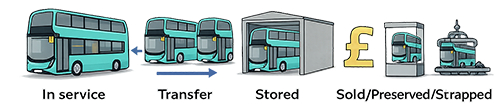
  • Transfer - a bus moving between depots or operators.
  • Displaced - a bus moved off a route because something newer replaced it.
  • Withdrawn - removed from service; may be stored, sold, scrapped, or preserved.
  • Awaiting Entry to Service - delivered or acquired but not yet in passenger service (e.g. being prepared, liveried, or tested).
  • Blind - older roll-film destination display (also used casually for destination screen content).
Lifecycle flow showing in service, transfer, stored, and sold/preserved/scrapped
A simple overview of what can happen to a bus over time.

Quick tips for BusOva contributors

If you’re ever unsure, it’s better to leave a field blank than guess. BusOva works best when entries are verifiable and consistent.

  • If you know the registration but not the fleet number, add the registration and leave fleet number blank.
  • If you’re unsure between two models, add a clear photo and use notes (or leave model blank if that’s your rule).
  • Use the Knowledge Hub to confirm terms before submitting - especially chassis/body combinations.
View real examples on BusOva
See real buses from the community that match what you’ve learned.
Explore buses
Add this bus to the database
Spotted one yourself? Help grow BusOva with accurate info.
Add a bus

Related guides